

Showing posts with label Research and development-Subsidiary task Poster. Show all posts
Showing posts with label Research and development-Subsidiary task Poster. Show all posts
Tuesday, March 22, 2011

Saturday, March 12, 2011
Qualitative feedback poster and Review
Feedback is a vital part in ensuring you have created a product that the consumer desires and that your product full fills this niche. In order to be sure that we have succeeded this, we acquired feedback through a mixed age range from our target audience to give us a great range of answers to our questions.
We interviewed six different people and they gave a range of answers both positive feedback and some constructive changes that could be made.
I have posted three out of the six videos below:
The questions we asked we both about the content of the subsidiary products but we also asked questions about the what would be the best place to exhibit both of them. Obviously our magazine review page was already going to be exhibited within empire magazine, but we had an empire magazine there which enabled us to ask questions involving the layout and tone of the review to find out if we had done our job and both written in the style that empire use as well as making our page look like an empire feature.
Magazine and poster feedback 1 from Tom palmer on Vimeo.
Magazine and Poster feedback 3 from Tom palmer on Vimeo.
The questions we asked we both about the content of the subsidiary products but we also asked questions about the what would be the best place to exhibit both of them. Obviously our magazine review page was already going to be exhibited within empire magazine, but we had an empire magazine there which enabled us to ask questions involving the layout and tone of the review to find out if we had done our job and both written in the style that empire use as well as making our page look like an empire feature.
The feedback was very good and we acquired a lot of potential information we could use when exhibiting our products an which places were best to do so.
We also asked questions involving what their expectations were after looking at the poster and we then asked similar questions after they had watched the film to find out if they thought the poster gave the right connotations or wether they thought they had been misled.
Over all the feedback session was great and both myself and Blaine learned a lot from the feedback and could adjust the products with their constructive criticism comments if we felt it necessary.
Monday, February 7, 2011
Out with the old and in with the new and improved poster
Both myself and Blaine discussed the film poster and after Blaine created a mock up of our initial poster idea which overall looked extremely unprofessional and did not in anyway shape or form get the audiences attention for the right reasons, apart from, that looks so rubbish I will point and laugh.
Blaine was unhappy with the outcome and decided to share his thoughts with me over the phone because I hadn't seen it yet. I trusted his judgement and he told me a new idea he had so after a long discussion (good thing I'm on contract) I said I would draw up some mocks of the new poster idea and below are two ideas that I envisioned from Blaine's explanation.
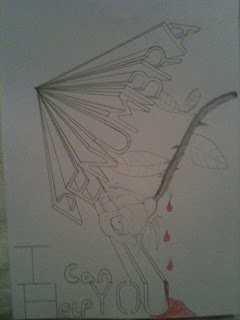

We then meet up the next morning for our three hours of media and exchanged more ideas. Blaine then set about the construction of our final poster with me on the sideline offering assistance and feedback, both positive and negative which we then discussed and compromised on certain features. Overall the poster looks great and I am happy that our first idea didn't work because I think that our new and improved version is much more interesting. Not only this but after reading the analysis of our qualitative questionnaire which wasn't available on the construction of our first poster, the three main features that our target audience wanted the poster to include were an eye-catching image, image of the main character and a catchy tag-line. Out of the three I think we have included a catchy image in the sense of the title, the layout of the multiple Penumbra titles with the images behind them are very eye-catching in my opinion but I will create a small feedback session for people to comment on the poster to finalize my oppinion. we also included a picture of the main character but not only this we included the forth most favorite answer within our questionnaire, which was a sense of mystery. This is also included because you cannot she the face of the main protagonist, even more than that, you do not know who or what his relationship is to the film is. His face can be seen within one of the Penumbra titles, but this still adds a sense of mystery because myself and Blaine know this but a random consumer of the poster will not. We didn't include a catchy tag-line because however much we tried to think of one which was ambiguous but not cheesy we couldn't decide on a final one. An idea was 'I can help you' but we decided that we wouldn't include this or any tag line because it is very risky in the form of being judged and criticized.
Blaine was unhappy with the outcome and decided to share his thoughts with me over the phone because I hadn't seen it yet. I trusted his judgement and he told me a new idea he had so after a long discussion (good thing I'm on contract) I said I would draw up some mocks of the new poster idea and below are two ideas that I envisioned from Blaine's explanation.
We then meet up the next morning for our three hours of media and exchanged more ideas. Blaine then set about the construction of our final poster with me on the sideline offering assistance and feedback, both positive and negative which we then discussed and compromised on certain features. Overall the poster looks great and I am happy that our first idea didn't work because I think that our new and improved version is much more interesting. Not only this but after reading the analysis of our qualitative questionnaire which wasn't available on the construction of our first poster, the three main features that our target audience wanted the poster to include were an eye-catching image, image of the main character and a catchy tag-line. Out of the three I think we have included a catchy image in the sense of the title, the layout of the multiple Penumbra titles with the images behind them are very eye-catching in my opinion but I will create a small feedback session for people to comment on the poster to finalize my oppinion. we also included a picture of the main character but not only this we included the forth most favorite answer within our questionnaire, which was a sense of mystery. This is also included because you cannot she the face of the main protagonist, even more than that, you do not know who or what his relationship is to the film is. His face can be seen within one of the Penumbra titles, but this still adds a sense of mystery because myself and Blaine know this but a random consumer of the poster will not. We didn't include a catchy tag-line because however much we tried to think of one which was ambiguous but not cheesy we couldn't decide on a final one. An idea was 'I can help you' but we decided that we wouldn't include this or any tag line because it is very risky in the form of being judged and criticized.
The last inclusion within the poster was the names of the main actors and directors upon the poster at the bottom which Blaine researched and found a font online which was very similar to the actual movie font that is used but free of charge. He found and installed a font called 'Rothman' which looked very authentic and works well upon the poster.
To view the all most finished poster with just some minor adjustments the poster is provided below:

Wednesday, February 2, 2011
Quantitative feedback analysis Blaine's blog
Both Blaine and I constructed a questionnaire to acquire information about potential consumers demographics which will help us to understand where we could advertise our short film, but as well as just finding out about their demographics we asked very guided questions about our subsidiary products, which would then help us within the construction process of both our poster and review. After analyzing the questionnaire results, the graphs show specific elements that consumers want to be included within these subsidiary products.
Blaine has provided some evidence of the results and analyzed what we have concluded from them.
 To view Blaine's post follow the link below:
http://blainekenneallya2media.blogspot.com/2011/02/quantitative-audience-research-analysis.html
Friday, January 14, 2011
Initial poster and review layout plans
Blaine has produced some drafts of some potential posters that we could use and he has also created a layout of a two page spread within a film magazine which we could place our review on. Because mainstream magazines do not really have reviews of short films unless they are very critically acclaimed. To read Blaine's post with detailed explanation of our choices follow the link below to his blog.


Wednesday, January 12, 2011
Classic movie posters and designers
Because we have to create a movie poster I thought it would be good to look at some classic movie poster and their designers.
Posters have been a strong form of advertising that many companies have adopted through the history of film production and advertising. There are many different aspects of a poster that can catch the eye of the consumer or intrigue them into the search to find out more.
The construction of a poster is not a simple task, there would be many people from a creative background, technical support and creation of the poster, researchers, Drawing artists and manager making sure that everything was above board and no rules and regulations were broken. This restrictions are a lot tighter to date but greater technology has been developed, bigger budgets are available consumer culture has changed and this has overall stemmed to new ways to advertising your film and make consumers aware of your product.


These very classic posters are just a small example of the wide range of posters that people created and how they connect with their target audience.
The E.T. and Blade runner posters were both created by John Alvin a very respected poster artist and has worked on over 200 posters.
The Clockwork orange poster was created by Philip Castle and many interpretations have been formed about the meaning behind he poster and this just shows the impact a poster can have upon your audience.
The Eraserhead poster created by Ben Barenholtz and director david lynch is just an example of how simple but effective a poster can be depending on your target audience and what you as the producer want to convey.
Marketing strategies have changed dramatically through the years but film posters still stand strong. Modern Posters have an exceptionally high standard and reputation for being extremely enticing with amazing concept art and stunning visual pleasures but at the other end of the spectrum they can also be very simple and very ambiguous. Many films do not just produce one poster anymore they create and original poster for the film but as the release date slowly becomes closer they release substitute posters creating world wide interest within audiences and build the excitement up until the release date.
I have found a really good website that hosts many images of posters called http://www.impawards.com/ and for some great examples of films that create more than one poster to create excitement within the potential consumers follow the links below for Inception and Tron Legacy which have over 15 exceptional posters each.
http://www.impawards.com/2010/inception.html
Thursday, December 9, 2010
Target audience for our short film poster
 CAP- Committee of advertising practice helps to regulate advertising codes which are set to protect consumers against advertisers that do not comply with the rules. This is the overall message that can see above their mission statment.
"The Advertising Codes contain wide-ranging rules designed to ensure that advertising does not mislead, harm or offend. Ads must also be socially responsible and prepared in line with the principles of fair competition. These broad principles apply regardless of the product being advertised.
In addition, the Codes contain specific rules for certain products and marketing techniques. These include rules for alcoholic drinks, health and beauty claims, children, medicines, financial products, environmental claims, gambling, direct marketing and prize promotions. These rules add an extra layer of consumer protection on top of consumer protection law and aim to ensure that UK advertising is responsible.
The ASA administers the rules in the spirit as well as the letter, making it almost impossible for advertisers to find loopholes or ‘get off on a technicality’. This common sense approach takes into account the nature of the product being advertised, the media used, and the audience being targeted."
For our poster advertisment we will have to abide by these rules and regulations that are set by the comittee of advertising practice. I have thouraghly read through the codes on their website and here are some examples of the general sections. Each one has its principle outlined a definition of its meaning and the rules that are set under the specific heading.
 There are also specific category sections that also have many rules within them, many sections relate to other sections and have links to other regulatory websites with their rules which you also have to abide by like the National lottery if you are advertising gambling.
 When creating our poster we will have to make sure that we do not break any codes set by the comittee of advertising practice because consumer legislation has to be thought of and kept to a high priority. The content within the poster will have to mimic the target audience that we are advertising towards, but must not offend potential consumers of the advertisment.
For detailed information of on the codes set by CAP follow the link below to their website were downlodable version of the regulations are avalible:
http://www.cap.org.uk/
Now that we have the codes and conducts to follow, we can start to focus on the content of our poster and who the poster will be predominantly aimed at.
 Blaine has already constructed a post about semiotics within taditional film posters
 and he is going to construct a post on the visual content that we want to include as well as some example texts that we may want our film title to be as well as some different texts for some credits. Above is a picture of the Psychologist Abraham Maslow's 'heirachy of needs' this motivationall theory wich was included within his 1943 paper “A Theory of Human Motivation” the theory is based upon the basic human needs that then build up to more complex needs such as self actulisation this motivational theory structure is used within many business corporations. However John Antonios has applied this theory to social media and the way that audiences have responded it is Similar to Maslow’s pyramid, in the social media counterpart we have to complete our “basic needs” before moving up to our “social needs” ultimately reaching our social optimization. This can conseqently help us to distribute our poster on various social networking sites and this use of Wee media proves how the heirachy of needs works.
Abraham Maslow also constructed a theory of 'how advertisements use human needs' This theory looks at where companies place their television and print adverts to make the maximum impact upon their audience and how adverts work to attract the audience to the product. The theory is based on typical human behavior that focuses on satisfying Certain basic types of needs.
The advertisements may address the consumer directly: for example 'Do you like watching great films, well watch this one' or you can advertise in-directly to your consumers for example making a situation in your advert that people can see themselves in or by creating an ambiguous and intriguing poster which will respond to their need for fulfilment, and consequently will make them want to find out more about the poster and overall the film it is advertising. This then links to the 'reception theory'/active consumer under the effects model.
Below are the nine most common basic human needs that occur most frequently within advertising.
Need to survive- Used by advetisments for food, drink, housing etc.
Need to feel safe- Advertisments for insurance, loans and banks promise security and freeedom from threats.
Need for affiliation or friendship- Adverts that focus on lifestyle choices like diet and fashion use people's desire to be popular. They may also threaten them with failure to be liked or fit in.
Need to nurture or care for something- Advertising which shows cute animal and small children brings this out in the viewer.
Need to achieve- Advertisments that are linked with winning, often promoted by sports personalities, tap into the need to succed at difficult tasks.
Need for attention- Advertisments for beauty products often play the need to be noticed and admired.
Need for prominence- Advertisements for expensive furniture and diamonds may use people's need to be respected and to have high social status.
Need to dominate- Advertisments for products like fast cars offer the possibility of being in control through the product.
Need to find meaning in life- Advertisments for travel or music may appeal to people's need for fulfilment.
When constructing our poster we will need to take into account both the demographics' of potential consumers as well as the psycho graphics. These two prominent categorization methods will be vital in making sure that our poster reaches the largest possible range of potential consumers, in order to make them aware of our film. Maslow's theory of targeting basic human needs will also come into consideration when drawing up some plans for potential posters and getting feedback for them.
Thursday, November 18, 2010
"poster for a short film: Semiotics" - Blaine Kenneally
The preparatory research for both of our ancillary products is under way, I have done some research into three different film magazines that we could aim our film review to be a feature in. All three film magazines have different tones to their reviews so I will be analysing them in a future post to then decide the writing style of our review. follow the link here to view this post: Film review analysis
Blaine Kenneally has done some great intial research into film poster's as this is the other ancillary product that we chose to create. To view his post follow the link below:
http://blainekenneallya2media.blogspot.com/2010/11/poster-for-short-film-semiotics.html
After reading his post, we talked together and came up with a couple of initial ideas for a poster but we need to do more research into the target audience of our short film first because then we can carry out some primary research but at the correct target audience. We could construct a questionnaire or carry out some face to face interviews asking the potential consumers some questions and oppinions on some existing posters to find out what they would expect to see on a poster aswell as what they would find interesting and eye catching.
Blaine Kenneally has done some great intial research into film poster's as this is the other ancillary product that we chose to create. To view his post follow the link below:
http://blainekenneallya2media.blogspot.com/2010/11/poster-for-short-film-semiotics.html
After reading his post, we talked together and came up with a couple of initial ideas for a poster but we need to do more research into the target audience of our short film first because then we can carry out some primary research but at the correct target audience. We could construct a questionnaire or carry out some face to face interviews asking the potential consumers some questions and oppinions on some existing posters to find out what they would expect to see on a poster aswell as what they would find interesting and eye catching.
Subscribe to:
Posts (Atom)